page-header

Plantar warts

Plantar Warts Treatment in Hyderabad | Expert Wart Removal at The Foot Doctor
Plantar warts are small, noncancerous growths that develop on the soles of the feet. They are caused by the human papillomavirus (HPV) and can be painful, especially when located on weight-bearing areas. Plantar warts are a common condition and can affect people of all ages, though they are particularly prevalent in children and teenagers.
Thank you for reading this post, don't forget to subscribe!

Plantar warts develop when the Human Papillomavirus (HPV) enters the skin through tiny cuts or cracks on the foot.
They often appear:

What Are Plantar Warts?

✔ On the heel or ball of the foot
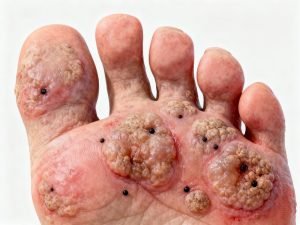
✔ As a rough, grainy, thickened skin patch
✔ With small black dots (“wart seeds” – tiny clotted blood vessels)

Because they grow inward due to pressure from standing and walking, they can feel like pebbles stuck inside your foot.

Causes of Plantar Warts
  • Human Papillomavirus (HPV): Plantar warts are caused by specific strains of HPV that enter the skin through tiny cuts, abrasions, or other breaks. The virus thrives in warm, moist environments such as locker rooms, public showers, and swimming pools.
  • Direct Contact: HPV can spread through direct contact with an infected person or surface.
  • Weakened Immune System: Individuals with weakened immune systems are more susceptible to HPV infections, including plantar warts.
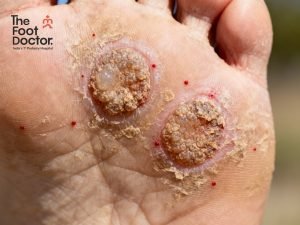
Plantar Warts
Symptoms of Plantar Warts
  • Small, Grainy Growths: Warts appear as small, rough growths on the soles of the feet.
  • Hard, Thickened Skin: The skin over the wart may be thick and callused.
  • Black Dots: Tiny black dots, often called wart seeds, which are small, clotted blood vessels, may be visible.
  • Pain or Tenderness: Walking or standing can be painful if the wart is on a weight-bearing area.
  • Clusters: Plantar warts can form in clusters called mosaic warts.
Prevention of Plantar Warts
  • Good Foot Hygiene: Keep feet clean and dry. Change socks daily and wear moisture-wicking socks if your feet sweat a lot.
  • Protective Footwear: Wear shoes or sandals in public showers, locker rooms, and around swimming pools.
  • Avoid Direct Contact: Do not touch or pick at warts, and avoid direct contact with others’ warts.
  • Avoid Sharing Personal Items: : Do not share towels, socks, or shoes with others.
  • Boost Immune System: Maintain a healthy lifestyle to support your immune system.
Treatment of Plantar Warts
Home Remedies
  • Salicylic Acid: Over-the-counter treatments containing salicylic acid can help dissolve the wart over time. Regular application and patience are required.
  • Duct Tape: Covering the wart with duct tape may help remove layers of the wart when the tape is replaced every few days.
  • Soaking and Filing: Soaking the foot in warm water and using a pumice stone or emery board to file down the wart can be effective.
Medical Treatments
  • Cryotherapy: A healthcare professional can freeze the wart using liquid nitrogen. Multiple sessions may be needed.
  • Cantharidin: A blistering agent applied to the wart by a healthcare provider, causing it to lift off.
  • Laser Therapy: Laser treatment can target and destroy the wart tissue.
  • Immunotherapy: Medications or injections to stimulate the immune system to fight the wart.
  • Minor Surgery: In some cases, surgical removal of the wart may be necessary.
Alternative Treatments
  • Cimetidine: An oral medication that may boost the immune response to help clear warts.
  • Intralesional Bleomycin: An injection of an antiviral medication directly into the wart.
FAQ's
  • Can I remove a wart at home?
    Self-removal may worsen infection or cause spread — best to consult a specialist.
  • Are plantar warts the same as corns?
    No. Corns are pressure-related; warts are viral and contagious.
  • Will the wart come back after treatment?
    Proper treatment + prevention steps greatly reduce recurrence.
  • Is wart treatment painful?
    Most treatments cause mild, temporary discomfort and are well tolerated.
  • Do plantar warts go away on their own?
    Sometimes — but it may take months to years and they often return.
Back to top of page