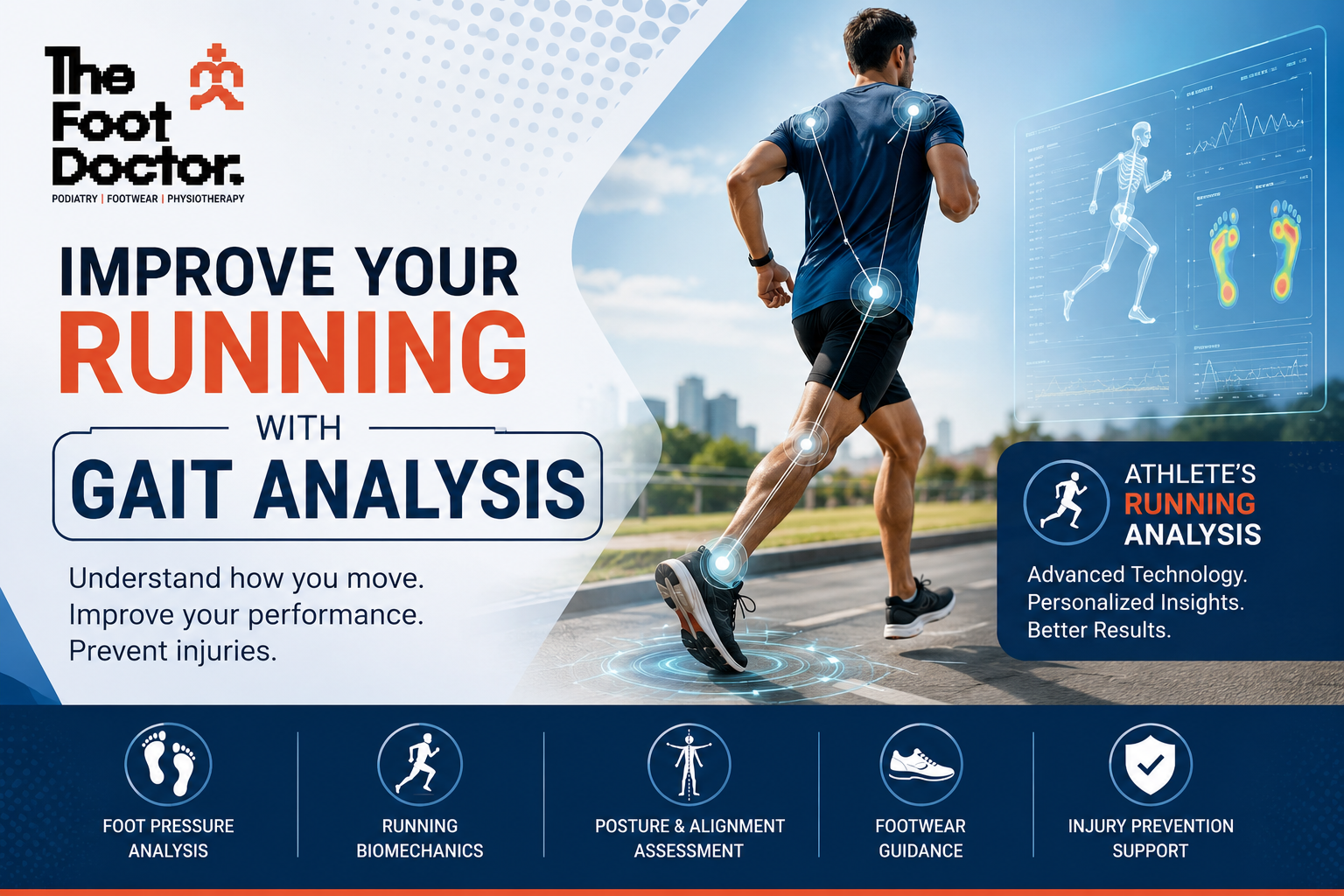
Running is more than simply putting one foot in front of the other. Every stride involves a coordinated movement of the feet, ankles, knees, hips and upper body. Small changes in your running gait, foot strike, stride, posture or biomechanics can influence how efficiently you run and how much stress is placed on different parts of your body.
This is why gait analysis for runners is becoming an important tool for recreational runners, marathon runners and athletes.
A professional running gait analysis evaluates how your body moves while walking or running. It can help identify movement patterns, asymmetries and biomechanical factors that may be affecting your running performance or contributing to recurring discomfort.
At The Foot Doctor in Hyderabad, gait analysis and Athlete’s Running Analysis use biomechanical assessment and advanced movement-analysis technology to help runners better understand their running mechanics and develop a personalized approach to performance and injury management.
What Is Gait Analysis for Runners?
Gait analysis is the systematic assessment of how a person moves while walking or running.
For runners, a gait assessment can examine different aspects of movement, including:
• Foot strike pattern
• Stride length
• Cadence
• Foot and ankle movement
• Pronation and supination
• Leg alignment
• Knee and hip movement
• Running posture
• Ground contact
• Weight distribution
• Right-left movement differences
Modern gait analysis can use technologies such as motion-capture cameras, pressure systems, force plates and wearable sensors to collect objective information about movement.
The goal is not to make every runner use exactly the same running technique. Instead, the assessment helps understand your individual running biomechanics and identify areas that may be relevant to your performance, comfort or injury history.
How Does Gait Analysis Improve Running Performance?
1. Identifies Inefficient Running Mechanics
Efficient running requires your body to coordinate movement and transfer forces effectively through each stride.
A running gait assessment can identify movement patterns that may be creating unnecessary movement or inefficient force transfer.
For example, differences between the right and left legs, excessive foot movement or changes in running posture may become more noticeable when analyzed objectively.
Understanding these patterns can help guide appropriate training, strengthening, mobility or running-technique strategies.
2. Helps Analyze Stride Length and Cadence
Stride length and cadence are important components of running mechanics.
Stride length describes the distance covered during a complete stride, while cadence refers to the number of steps taken per minute.
There is no single stride length or cadence that is perfect for every runner. These factors can vary depending on height, speed, fitness, terrain, fatigue and individual biomechanics.
A gait analysis can measure these characteristics and help you understand how they change while running.
3. Evaluates Foot Strike and Foot Movement
Your feet are the first part of your body to interact with the ground during running.
A running gait analysis can evaluate aspects of foot movement such as foot strike, pronation, supination, foot progression, weight transfer, pressure distribution and ankle movement.
This information can be especially useful for runners who experience recurring foot, heel, ankle, shin or knee problems.
4. Helps Identify Running Asymmetry
Perfect symmetry is not necessary for every runner. However, noticeable differences between the two sides may be worth evaluating, particularly when they occur with pain, weakness or a history of injury.
A running gait analysis can compare the movement of the right and left sides and identify differences in stride, foot loading, joint movement, ground contact and weight distribution.
Identifying these differences can help a clinician determine whether further assessment or rehabilitation may be appropriate.
5. Supports Better Footwear Selection
Your running shoes influence how your feet interact with the ground, but the best running shoe is different for every individual. A gait assessment can provide useful information about your foot movement, loading patterns and running mechanics
Based on the overall assessment, a foot and ankle specialist may recommend considering specific footwear characteristics. In some cases, orthotic support may also be considered when clinically appropriate.
6. Helps With Running Injury Assessment
Running injuries can have multiple contributing factors. Training errors, sudden increases in running distance, inadequate recovery, muscle weakness, previous injuries, footwear and individual biomechanics may all play a role.
Gait analysis can provide useful biomechanical information as part of a broader clinical assessment.
It may be particularly relevant for runners experiencing recurring plantar fasciitis, heel pain, Achilles tendon pain, shin pain, ankle pain, knee pain or sports-related foot injuries.
Importantly, gait analysis should not be considered a guarantee that an injury will be prevented. Instead, it provides another source of information that can help guide individualized assessment and management.
7. Supports Recovery After a Running Injury
Returning to running after an injury requires more than simply waiting for pain to disappear.
Some runners unconsciously change their movement after an injury. They may alter their stride, avoid loading one side or change their foot placement.
A gait assessment after injury can help evaluate these movement changes and monitor progress during rehabilitation.
Depending on the injury, assessment may be combined with strength testing, mobility assessment, physical rehabilitation, footwear evaluation, orthotic assessment and training-load modification.
8. Helps Runners Understand Their Biomechanics
One of the biggest advantages of gait analysis is that it converts movement into measurable information.
Instead of relying only on how your running feels, a professional assessment can provide objective information about your movement.
This can help answer questions such as: How does my foot strike the ground? Is my right side moving differently from my left? How does my stride change as I run? Could my running pattern be related to recurring discomfort? What areas should I work on to improve my running?
Who Can Benefit From Running Gait Analysis?
You do not have to be a professional athlete to benefit from gait analysis.
A running gait analysis in Hyderabad may be useful for recreational runners, marathon and long-distance runners, athletes, runners with recurring pain, runners returning after injury, and beginners starting a running program.
What Happens During a Running Gait Analysis?
Step 1: Running History
The clinician may ask about your running experience, weekly mileage, training schedule, previous injuries, current symptoms, running goals and footwear.
Step 2: Foot and Lower-Limb Assessment
Your feet, ankles and lower-limb alignment may be evaluated to identify factors that could influence running mechanics.
Step 3: Running Movement Analysis
You may be asked to walk or run while your movement is recorded and assessed. The Foot Doctor’s Athlete’s Running Analysis uses advanced motion-capture technology to evaluate running movement, including factors such as foot strike, stride length and posture.
Step 4: Biomechanical Evaluation
The collected information can be reviewed to understand movement patterns involving the feet and lower limbs. Depending on the assessment, factors such as joint movement, foot alignment, loading and movement symmetry may be considered.
Step 5: Personalized Recommendations
The findings can help guide recommendations based on your individual goals and clinical needs. These may include running-technique adjustments, strengthening exercises, mobility exercises, rehabilitation, training modifications, footwear recommendations and orthotic assessment when appropriate.
Can Gait Analysis Make You Run Faster?
Gait analysis does not automatically make you faster.
Instead, it provides information about how you move while running.
For some runners, identifying and addressing inefficient movement patterns may help improve running comfort, movement efficiency or training quality.
For competitive athletes, biomechanical information may also be useful when optimizing running technique and training.
Is Gait Analysis Useful for Injury Prevention?
Gait analysis can help identify certain movement characteristics that may be relevant to an individual’s injury history.
However, running injuries are multifactorial. A sudden increase in mileage, inadequate recovery, muscle weakness, training intensity, previous injury and other factors can contribute to running injuries.
Therefore, gait analysis should be viewed as one part of a complete running assessment, rather than a guarantee against injury.
Gait Analysis vs. Simply Watching Yourself Run
It can be difficult to identify subtle movement differences when watching yourself run.
A professional gait assessment can provide a more structured evaluation of running mechanics.
Instead of simply asking whether your running form looks right, an assessment can examine measurable aspects of movement and help determine whether particular findings are relevant to your symptoms or goals.
Why Choose The Foot Doctor for Gait Analysis in Hyderabad?
The Foot Doctor is a dedicated podiatric hospital in Hyderabad providing advanced foot and ankle care. Its services include gait analysis and Athlete’s Running Analysis for runners and active individuals.
The Athlete’s Running Analysis focuses on understanding running mechanics through advanced motion analysis, biomechanical assessment, foot and lower-limb evaluation, running movement assessment, personalized footwear guidance, performance-focused recommendations, and injury-risk assessment and rehabilitation support.
Improve Your Running With a Personalized Gait Assessment
Running better is not always about running more.
Understanding how you run can help you make better decisions about your training, footwear, rehabilitation and running technique.
A professional gait analysis for runners provides objective information about your movement and can help identify biomechanical factors that may be relevant to your running goals.
Whether you are a beginner, recreational runner, marathon participant or competitive athlete, a personalized running assessment can help you better understand your body and your running mechanics.
Book Gait Analysis in Hyderabad
If you experience recurring foot or lower-limb discomfort, are returning to running after an injury, or simply want to understand your running biomechanics, consider a professional running gait analysis in Hyderabad.
The Foot Doctor provides gait analysis and Athlete’s Running Analysis to help runners understand their biomechanics and work toward more efficient, comfortable and sustainable running.
Book an appointment with The Foot Doctor today and take a data-driven approach to your running performance.
Frequently Asked Questions About Gait Analysis
What is gait analysis in running?
Gait analysis in running is the assessment of how your feet and body move during running. It can evaluate foot strike, stride, cadence, posture, joint movement, loading and movement symmetry.
How can gait analysis improve running performance?
Gait analysis provides objective information about running mechanics. The findings can help guide personalized recommendations related to running technique, strength, mobility, footwear and rehabilitation.
Is running gait analysis only for professional athletes?
No. Recreational runners, marathon runners, beginners and athletes can all potentially benefit from a running gait assessment, particularly when they have recurring symptoms or specific performance goals.
Can gait analysis identify the cause of running pain?
Gait analysis can identify movement patterns that may be relevant to your symptoms. However, running pain can have multiple causes, so a complete clinical assessment may be necessary to determine the underlying problem.
Can gait analysis help with plantar fasciitis?
Gait analysis may provide useful information about foot movement and loading in people with plantar fasciitis. However, treatment should be based on an individual clinical assessment.
Can gait analysis help with Achilles tendon problems?
A gait assessment can provide information about running mechanics that may be relevant to Achilles tendon symptoms. A foot and ankle specialist can determine whether further assessment or treatment is required.
Do I need custom orthotics after gait analysis?
Not necessarily. Orthotics are not automatically required after gait analysis. They should only be considered when they are appropriate for the individual’s clinical findings and functional needs.
Where can I get gait analysis in Hyderabad?
The Foot Doctor provides gait analysis in Hyderabad and offers a dedicated Athlete’s Running Analysis service for runners and active individuals.
Conclusion
Gait analysis can give runners a clearer understanding of how their feet and body move during running.
By evaluating running mechanics, foot movement, stride, posture and other biomechanical factors, gait analysis can provide useful information for performance optimization, injury management and rehabilitation.
However, the best running strategy is always individualized.
If you want to understand your running mechanics or are dealing with recurring running-related foot or lower-limb problems, a professional gait analysis in Hyderabad can be an important part of your assessment. The Foot Doctor — helping you understand your feet, improve your movement and run with confidence
