Foot wounds and treatment assessment
Topical Oxygen Therapy (TOT) in Hyderabad
A foot ulcer that is slow to heal needs a clear treatment plan. Learn where topical oxygen therapy may fit, and contact The Foot Doctor for a wound assessment and guidance on suitable care.
Confirm the consultation branch, treatment availability and referral arrangements before travelling.
What is topical oxygen therapy?
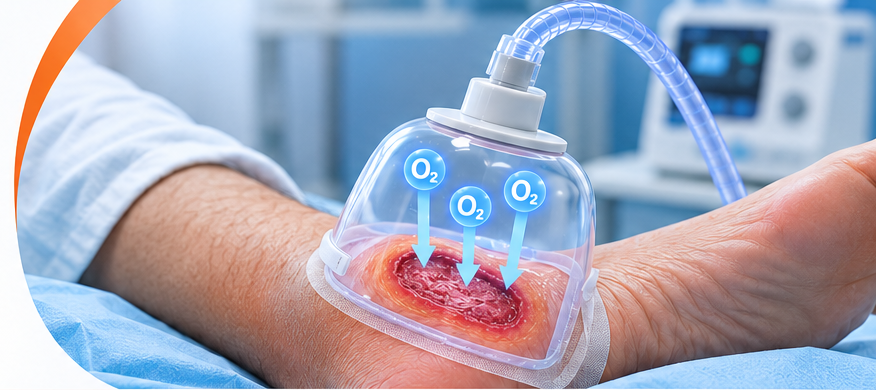
Topical oxygen therapy delivers oxygen directly to the wound area through a specialised medical device. Depending on the system, oxygen reaches the wound through a small delivery interface beneath a dressing or through a local enclosure around the affected limb. [3] [4]
TOT is different from hyperbaric oxygen therapy (HBOT) , which involves breathing oxygen inside a pressurised chamber. [5]
Who may benefit from TOT?
TOT may be considered for selected diabetes-related foot ulcers when appropriate standard wound care has not achieved healing. It is an additional treatment, rather than a replacement for the rest of the care plan. [1]
What does the evidence say?
The 2023 IWGDF guideline makes a conditional recommendation for topical oxygen in this setting, with low certainty of evidence. Some studies suggest improved ulcer healing, but results vary. The guideline did not establish a reduction in amputations during the available short follow-up. No device was established as superior. [1]
For other wound types, ask the clinician whether the proposed device is appropriate and what evidence supports its use. A non-healing wound should first be assessed to identify why it is not improving.
Read about our diabetic foot and wound-care consultation .
How is topical oxygen delivered?
Continuous local delivery
Some portable systems deliver oxygen through tubing to an interface beneath a compatible wound dressing. The prescribed device determines how it is worn, maintained and used. [3]
Intermittent local treatment
Other systems use a local chamber or enclosure around the affected limb during scheduled sessions. Some apply controlled local pressure. This differs from whole-body hyperbaric treatment. [4]
There is no single session length or treatment schedule that applies to every TOT device.
Assessment and treatment planning
- Examine the wound. The clinician checks its location, size, depth, duration and signs of infection.
- Assess contributing problems. Circulation, sensation, repeated pressure and diabetes management can affect the care needed.
- Continue essential wound care. This may include appropriate dressings, removal of dead tissue when indicated, pressure relief and treatment of infection or poor blood supply. [2]
- Agree on the proposed device and plan. Ask how to use it, who will change the dressings, what to do if it stops working and when progress will be reviewed.
- Review the response. Follow-up should guide whether to continue, change or stop the additional treatment. Tell the team about increasing pain, leaking dressings or equipment problems. [3]
Before agreeing to treatment, ask what improvement the team expects, how it will be measured and what happens if the wound does not improve.
Safety and home-use precautions
Home use is possible with some prescribed systems after training and with ongoing clinical supervision. Follow the instructions for the actual device, including dressing compatibility and equipment care. [3] [4]
- Keep smoking, flames and ignition sources away from oxygen equipment. Oxygen can make a fire burn more intensely. [4]
- Use only the prescribed system and settings; do not improvise a wound treatment using an oxygen cylinder.
- Ask for written contact and troubleshooting instructions before starting.
Topical oxygen therapy vs HBOT
| Feature | TOT | HBOT |
|---|---|---|
| Where oxygen goes | Directly to the wound area. | The patient breathes oxygen inside a pressurised chamber. |
| Equipment | A wound interface, dressing system or local limb enclosure. | A hyperbaric chamber with specialist supervision. |
| Schedule | Continuous use or scheduled sessions, depending on the device. | A prescribed course of chamber sessions. |
| Selection | The diagnosis, clinical assessment and treatment goals determine whether either approach is appropriate. They are not interchangeable. | |
Sources: manufacturer descriptions of topical systems [3] [4] and Mayo Clinic's HBOT overview [5].
Planning a wound consultation in Hyderabad
Bring previous wound-treatment records, your medicine list and any available blood-test, circulation-test or imaging reports. Note when the wound started and what treatment you have already tried.
Ask the team to confirm the consultation location, whether the proposed therapy is provided there or through referral, and the expected follow-up arrangements.
What should a cost estimate include?
Request a written estimate covering assessment, device purchase or rental if applicable, disposable parts, dressings and review visits. Ask which items are included and which are charged separately. A personalised treatment quote requires assessment; this page does not state a fixed package price.
When a foot wound needs urgent attention
Seek immediate medical assessment for a foot ulcer with fever, rapidly spreading redness, suspected deep infection, black tissue or a suddenly cold or discoloured foot. If you feel seriously unwell, go to an emergency department. Do not wait for an appointment enquiry or WhatsApp reply. [6]
Any new diabetic foot wound needs prompt professional attention, even if it is small or painless. [6]
Frequently asked questions
Is TOT the same as hyperbaric oxygen therapy?
No. TOT applies oxygen locally to a wound. HBOT involves breathing oxygen inside a pressurised chamber. [5]
Is topical oxygen suitable for every diabetic foot ulcer?
No. It is an option for selected ulcers after assessment, when appropriate standard care has not achieved healing. [1]
How long does treatment take?
It depends on the device and clinical response. Ask for both the daily schedule and the planned review dates. Continuous systems and intermittent systems have different routines. [3] [4]
Can TOT be used at home?
Some systems can be used at home when prescribed, with training and clinical monitoring. Confirm that the specific device and support arrangements are suitable for you. [4]
Is topical oxygen therapy painful?
Local oxygen delivery is intended to be non-invasive. Tell your treating team about new or increasing pain rather than assuming it is normal. [3]
Can TOT replace dressings or pressure relief?
No. Continue the wound-care and pressure-relief plan prescribed by your clinician. [2]
What is the cost of TOT in Hyderabad?
Ask for an individual estimate after assessment. The proposed system, consumables, dressings and review schedule determine the quote. Confirm any insurance approval directly with your insurer.
How do I enquire about treatment?
Contact The Foot Doctor for a wound consultation. The team can clarify appointment availability, the consultation branch and treatment or referral arrangements.
Discuss the next step for your foot wound
Request a consultation with The Foot Doctor in Hyderabad to discuss your wound, previous treatment and suitable next steps.
Call 88665 49555 or 89775 44192Email info@thefootdoctor.in
Please confirm the location and treatment arrangements before travelling.
Medical references
- IWGDF 2023 wound-healing guideline : recommendation 13 and evidence review.
- IWGDF 2023 practical guidelines : foot-ulcer assessment and treatment.
- Continuous topical oxygen: NATROX product overview and patient information .
- Local chamber systems: AOTI product overview and patient information and safety precautions .
- Mayo Clinic: Hyperbaric oxygen therapy .
- NICE: Diabetic foot problems : assessment and urgent referral.
Manufacturer references explain device operation; they do not imply that The Foot Doctor uses or endorses those brands.
This page provides general educational information and does not replace a medical consultation. Treatment selection and device instructions must come from qualified healthcare professionals. Individual outcomes vary; healing is not guaranteed.